
Spring Gardening Tips

Follow the 10 tips outlined below for a welcoming garden that's filled with color and fragrance -- and song.
Survey the Yard
Make note of tree limbs that should be removed or cabled, especially those that overhang structures. Hire an arborist to maintain large trees.Cut down last year's perennial foliage, and toss it into the compost pile. Rake mulch from beds planted with bulbs before foliage appears, and refresh mulch in other planting areas after soil warms. Check fences, steps, and pathways for disrepair caused by freezing and thawing.
Make note of tree limbs that should be removed or cabled, especially those that overhang structures. Hire an arborist to maintain large trees.Cut down last year's perennial foliage, and toss it into the compost pile. Rake mulch from beds planted with bulbs before foliage appears, and refresh mulch in other planting areas after soil warms. Check fences, steps, and pathways for disrepair caused by freezing and thawing.
Order Tools and PlantsTune up tools so everything is ready when things start growing. Make note of what is missing, and order tools for the new growing season. Choose new plants for the garden. Order perennials, trees, and shrubs for spring planting.
Get Ready to Mow Send the mower and leaf blower for servicing, or if you have the right tools, sharpen the mower blades yourself. Refill your mower with oil, install fresh spark plugs, and lubricate moving parts if necessary. Clear the lawn of winter debris, and look for areas that need reseeding before mowing.
Prune Trees and ShrubsRemove dead, damaged, and diseased branches from woody plants. Thin and trim summer-blooming shrubs such as butterfly bush, hydrangea, and most roses, except for old-fashioned once bloomers. Prune cold-damaged wood after plants resume spring growth. Prune spring-blooming shrubs and trees after flowering.
Take a Soil TestCheck soil pH with a home soil- test kit, taking several samples from different planting areas for an accurate reading. Enrich soil as necessary: Add dolomitic lime to raise the pH or elemental sulfur to lower the pH.
Prepare New BedsClear the planting area as soon as soil can be worked, removing sod or weeds and debris. Spread a 4-inch layer of compost or well-rotted manure and any amendments over soil, and cultivate it to a depth of 10 to 12 inches with a spading fork.
PlantPlant bare-root trees, shrubs, and perennials such as hostas and daylilies by early spring. Choose a cool, cloudy day if possible. Transplant container-grown plants anytime during the growing season except midsummer; be sure to water them thoroughly. Sow seeds of cool-season flowers like sweet peas, poppies, and calendula, and vegetables such as lettuce, parsley, and spinach.
FertilizeApply balanced fertilizer (6-6-6 or 8-8-8), fish emulsion, or other soil amendments recommended by soil-test results around trees and shrubs when new growth appears. Spread high-acid fertilizer and pine-needle mulch around acid-loving shrubs like azaleas and camellias. Begin fertilizing perennials when active growth resumes.
Start a Compost PileStart a compost pile, or use a compost bin, if you don't have one already. Begin by collecting plant debris and leaves raked up from the garden. Chop these up first to speed decomposition. Add equal amounts "brown" (carbon-rich) materials like dried leaves and straw and "green" (nitrogen-rich) materials like grass clippings and weeds in even layers with water and a compost bioactivator. Turn regularly. Continue adding to the pile throughout the season for rich, homemade compost next spring.
Clean Bird Feeders and Baths
Disinfect the feeders by scrubbing with weak bleach solution (1/4 cup bleach: 2 gallons warm water). Rinse and dry the feeders thoroughly before refilling them.Scrub birdbaths with bleach solution, then rinse them thoroughly and refill, changing water weekly. Clean birdbaths and feeders regularly throughout the season.
Disinfect the feeders by scrubbing with weak bleach solution (1/4 cup bleach: 2 gallons warm water). Rinse and dry the feeders thoroughly before refilling them.Scrub birdbaths with bleach solution, then rinse them thoroughly and refill, changing water weekly. Clean birdbaths and feeders regularly throughout the season.
Read more at Marthastewart.com: Spring Gardening Tips - Martha Stewart Home and Garden


California Water Summary
Reducing water usage 20% is going to be tough. Here is a look at where we are.
http://www.edf.org/documents/4033_hetchhetchyrestored_Chap03.pdf
http://www.edf.org/documents/4033_hetchhetchyrestored_Chap03.pdf
Monarch Monthly Newsletter
Dear Friends,
This week's publication is dedicated to all things 2011. Learn about new tax laws, hot home improvement trends, eagerly anticipated album releases, and much more.
www.clientappreciationprogramweb.com/01-11_Monarch_News.pdf <http://www.clientappreciationprogramweb.com/01-11_Monarch_News.pdf>
This week's publication is dedicated to all things 2011. Learn about new tax laws, hot home improvement trends, eagerly anticipated album releases, and much more.
www.clientappreciationprogramweb.com/01-11_Monarch_News.pdf <http://www.clientappreciationprogramweb.com/01-11_Monarch_News.pdf>
Winter Landscape Tips
During the winter, sprinkler irrigation is limited to one assigned day per week. Make sure you water on your assigned watering day.
Watering restrictions also apply to drip irrigation. Sunday is not an optional watering day.
Water in the midmorning to avoid the afternoon winds that keep your sprinklers from hitting their grass target. You also will reduce the risk of icing that can occur if you water during early morning or evening.
Water in the midmorning to avoid the afternoon winds that keep your sprinklers from hitting their grass target. You also will reduce the risk of icing that can occur if you water during early morning or evening.
Check your sprinklers
Turn on your sprinklers after you mow and scan for broken or misaligned heads, as well as broken pipes. A twisted head could water your sidewalk instead of your grass.
Daylight saving time ends
Don't forget to reset your irrigation clock when daylight saving time ends on the first Sunday in November. When you're changing your indoor clocks, make sure you also change the time on your irrigation clock. This also is a great time to check your clock's batteries.
Protect new plants
February is usually mild enough to allow you to plant petunias, pansies, snapdragons and other cool-season annuals in a well-drained, highly enriched soil. Adding a protective mulch on the soil around your plants will conserve water so you don't have to water as often. Remember to stake new plants and water them deeply to prevent damage from winds and burning young leaves.
Revive roses
Fertilize established rose bushes now to encourage spring blooms and put down a 3-inch layer of mulch around each plant. Always water before and after applying fertilizer.
Fertilize fruit plants
Peak blooming season is in the spring, and the best time to fertilize fruit trees and grapes is the six weeks before and after they bloom. Fertilize in late winter for the finest fruit.
Protect pipes and hoses
There are several steps you can take to protect the pipes and hoses in your home and landscape from cold weather:
- Disconnect and drain garden hoses when they are not being used.
- Insulate your irrigation backflow device by draping a towel over it and cover with a bucket or other protective cover that touches the ground.
- Wrap exposed irrigation pipes with pipe insulation, insulated "faucet socks," an old towel or duct tape.
- Set heat to 55 degrees when you're away to protect pipes and houseplants.
- Turn off the water valves to your washing machine to avoid flooding from burst hoses.
- Don't leave interior or exterior pipes dripping. Valley temperatures generally don't drop low enough for a long enough period of time to warrant it.
- Locate your water shut-off valve and learn how to turn off water at its source, so you can ward off damage from leaks or burst lines. Know how to turn off your irrigation backflow device as well.
Leave damaged plants alone
If you notice frost or a freeze has damaged a plant, leave it alone until warmer weather arrives and new growth appears. Pruning or transplanting a damaged plant during winter months can hurt or even kill it.
Pruning
The ideal time to prune trees and shrubs is in late winter, when plants are mostly dormant. Finish heavy pruning by mid-February, before buds show evidence of swelling. Don't prune more than one-quarter of the living tissue during the year.
Southern Nevada Water Authority
Southern Nevada Water Authority
Are we out of this drought yet?
Although it seems that the rains we have had in Southern California would be more than enough to get us out of a drought- this may not be true. While some reservoirs are able to capture and hold the rain water most of it is not able to be absorbed by the soil after reaching field capacity. Once the saturation point is reached the water simply sheets off down the drains and out to the ocean. Rainwater that precipitates in January is not available in July. Simply stated that water is consumed. To end the drought two major factors need to occur: 1. Rain sporadically all year long 2. Population growth will have to come to a complete stop. Since neither of these is likely we will have to continue to worker smarter to make each drop of water go farther.
New Rebate Info
IMPORTANT: PLEASE forward this notice to all appropriate sales and customer service personnel.
 | |||||||||||||
November 2010 NewsONLINE APPLICATIONAccount or Parcel Numbers Are OptionalWe simplified the online application process by making customers' water account number (and/or parcel number) optional. If customers have questions about any aspect of the rebate process, please refer them to www.socalwatersmart.com or (888) 376-3314. DON'T WAITTwo-Step Rebate ApplicationBe sure to remind your customers to complete the online application as soon as possible and to mail the following required documents within 60 days of their online application.
Please note: Old hard copy application forms expired May 31, 2010 and cannot be accepted. For customer convenience, please recycle any old application forms you have on hand. WE CAN HELP!Quick Links to Program Resources |
Replace Your | ||||||||||||

 The baseline rebate amount is now $85 for high-efficiency clothes washers. For new product labels or to schedule a program training session for your store location, please

MWDOC gives Monarch a great press release
Municipal Water District of Orange County put out the following Press Release.
http://www.mwdoc.com/newsletter/July_2010/Oso_Valley.pdf
http://www.mwdoc.com/newsletter/July_2010/Oso_Valley.pdf
Monarch Monthly Newsletter
Save Money, Water get more out of your contractor and receive a monthly newsletter. Pretty sweet deal.
www.clientappreciationprogramweb.com/Monarch_Automate.pdf <http://www.clientappreciationprogramweb.com/Monarch_Automate.pdf>
www.clientappreciationprogramweb.com/Monarch_Automate.pdf <http://www.clientappreciationprogramweb.com/Monarch_Automate.pdf>
What are you waiting for. Be a hero TODAY.
Monarch Monthly Mailer
Not just another Landscape newsletter.
In this week's newsletter, you will find an important update about the home buyer tax credit, creative ideas for taking your BBQ's to the next level, 3 iPhone apps for a better summer, and much more.
www.
In this week's newsletter, you will find an important update about the home buyer tax credit, creative ideas for taking your BBQ's to the next level, 3 iPhone apps for a better summer, and much more.
www.

Monarch's Client Receiving Award
Monarch has been working with Oso Valley Greenbelt since 2008. Since 2008, Oso Valley has made some incredible changes and improvements which have resulted in over $250,000 saved in water consumption. Incredible!!! Monarch works with the team in place to establish planning, review contracts, manage water and so much more. The results are money saved, better looking landscapes and increased property values. The City of Mission Viejo is making a proclamation about the efforts and incredible savings made at Oso Valley. Well done board, Harvest Landscape, PCM and Monarch. Tens of thousands more were saved- contact Monarch to find out how.
Check out the article. . .
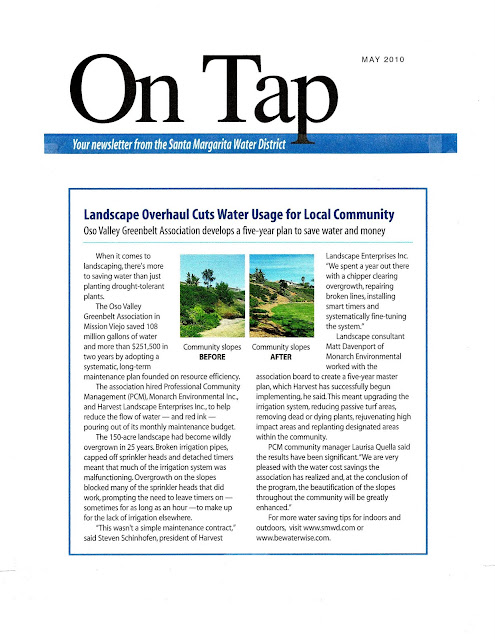
Check out the article. . .

Smart Timers

Subscribe to:
Posts (Atom)


